
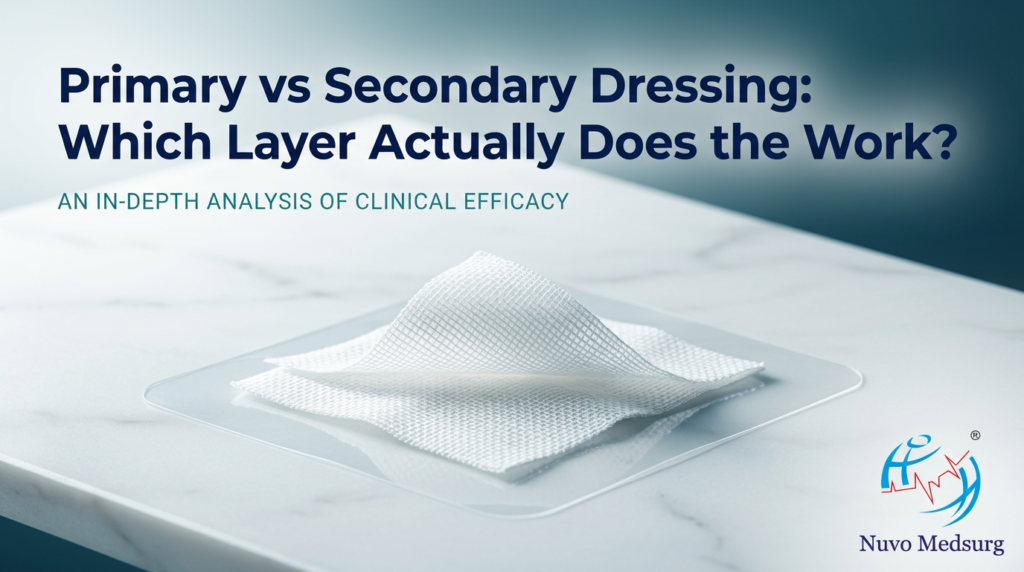
Ask two nurses on the same ward what “the dressing” means and you can get two different answers. One means the gauze touching the wound. The other means the crepe bandage holding it in place. In a busy Indian hospital running through dozens of dressing changes a shift, that mix-up costs time and occasionally causes a real error, like a bandage applied where a sterile pad was needed.
Quick Answer
The primary dressing does the clinical work of managing the wound bed. The secondary dressing does the mechanical work of holding it there and keeping the outside world out. Most routine surgical wounds need both, and the split matters most on heavily exuding or chronic wounds.
Quick Comparison
| Primary Dressing | Secondary Dressing | |
| Touches the wound bed | Yes, always | No |
| Main job | Absorb exudate, protect the wound bed | Hold the primary layer, add cushioning |
| Must be sterile | Always | Not necessarily |
| Common materials | Gauze, alginate, hydrocolloid, foam | Crepe bandage, adhesive tape, retention wrap |
Function and Wound Contact
The primary dressing is the only layer designed and licensed to sit directly on living tissue, which is why it carries the sterility burden and actually influences healing. The secondary dressing never touches the wound bed and its material choice has no direct effect on healing speed. Verdict: the primary dressing is the clinical decision, the secondary dressing is the practical one.
Exudate Management
Primary dressings are engineered around exudate: alginate and foam are chosen for absorptive capacity, hydrocolloids for adding moisture to a dry wound. A secondary dressing adds backup absorbency at best. If fluid soaks through to the outer layer faster than expected, that usually points to the wrong primary dressing, not a secondary dressing problem. Verdict: primary dressing choice controls exudate outcomes.
Infection Control and Wear Time
Both layers contribute to infection control, but differently: the primary layer’s sterility is non-negotiable, while the secondary layer works by physical exclusion of dust and contact. A sterile primary dressing loosely secured by a poor-fitting secondary layer can still leave a wound exposed. Wear time is usually set by the primary dressing (daily for heavy exudate, several days for low exudate), with the secondary layer changed on the same schedule. Verdict: infection control needs both layers working together.
Choosing the Right Pairing
A straightforward surgical incision needs a low-adherent primary pad with a simple tape secondary layer. A diabetic foot ulcer or pressure injury needs a moisture-retentive primary dressing paired with a more absorbent secondary layer for longer wear. For burns, the primary dressing has to avoid adhering to fragile new tissue, which matters more than the secondary layer’s absorbency.
Cost and Procurement
Primary dressings carry the larger share of a wound care budget, since advanced options like alginates and hydrocolloids cost more per unit than basic gauze. Secondary dressings are cheaper per unit but used in higher volume across nearly every department. Procurement teams get the most consistent results standardising both categories with one certified manufacturer rather than mixing suppliers, which introduces variability nursing staff has to compensate for at the bedside.
Conclusion
A hospital does not choose between a primary and a secondary dressing, it chooses both and matches each to the wound in front of it. Nuvo Medsurg manufactures both primary and secondary dressing materials, including gauze, bandages, and absorbent pads, under ISO 13485 and CE quality standards. The full range is available at https://nuvomedsurg.com/.
Reviewed by the Nuvo Medsurg clinical content team.
Frequently Asked Questions
Can one product serve as both primary and secondary dressing?
Some modern composite dressings combine both functions, though most Indian hospital settings still use the traditional two-layer system for cost and flexibility.
Does the primary dressing need to be sterile even for a small wound?
Yes, sterility of the primary layer is non-negotiable regardless of wound size, since it is in direct contact with living tissue.
How do I know if I picked the wrong secondary dressing?
The clearest signs are strike-through, the dressing shifting out of place between changes, or visible skin marking from a wrap applied too tightly.
Can primary and secondary dressings be from different manufacturers?
Yes, but consistency in fit and adherence performs best when compatible product lines are used together, which is why many hospitals standardise both layers from a single supplier.
What happens if a secondary dressing gets wet?
It should be changed promptly, since a saturated secondary dressing can no longer protect the primary layer from external contamination.


