
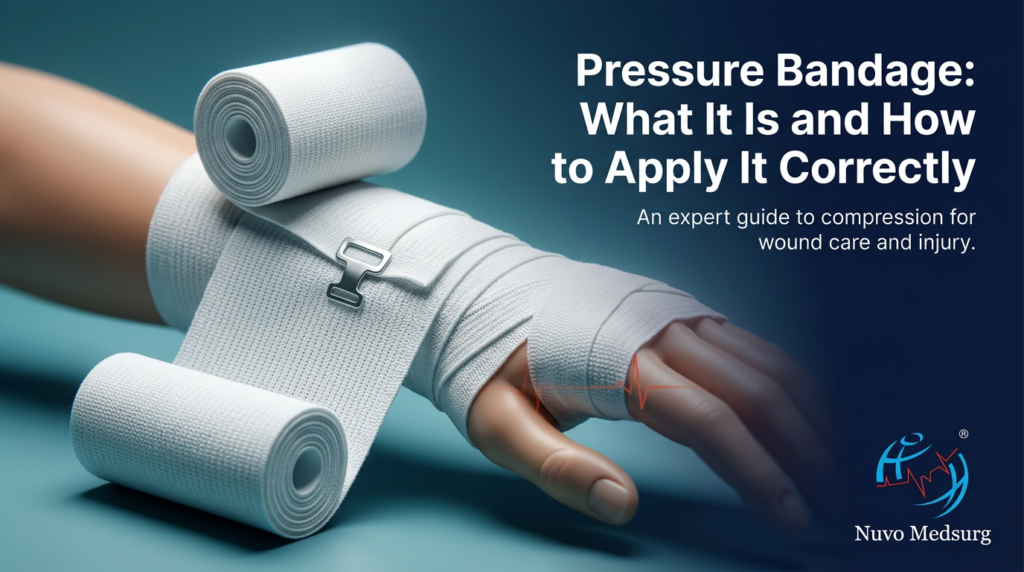
A pressure bandage controls bleeding and stabilises a wound by applying firm, even compression over the injury site. Nursing staff, first responders, and surgical teams use it daily, yet incorrect application is common and can cause more harm than the original wound. This guide explains what a pressure bandage is, where it is used, the types available, and how to apply one correctly.
Quick Answer
A pressure bandage is a firm compression wrap applied over a wound or dressing to control bleeding and limit swelling. It works by applying steady, even pressure across the injury without cutting off circulation, and it should always be checked for colour, warmth, and sensation in the area beyond it after application.
What Is a Pressure Bandage
A pressure bandage is a compression bandage applied directly over a wound, usually on top of a sterile dressing or gauze pad. Its job is to press against the bleeding vessel and surrounding tissue firmly enough to slow blood flow and support clot formation, without restricting circulation to the rest of the limb. It differs from an ordinary roller bandage in how tightly and evenly it is wound, and it is often the first compression measure used before a wound is closed with sutures or staples. Pressure bandages are typically made from elastic or crepe fabric that stretches to conform to the body while holding tension.
Primary Clinical Uses of a Pressure Bandage
Pressure bandages are used most often to control active bleeding from cuts, lacerations, and post-surgical wounds. Emergency and trauma teams apply them as first-line bleeding control before more advanced measures are needed. In surgical settings, a pressure bandage supports the wound site after suturing or stapling to reduce swelling and protect the closure during the early healing period. Sports medicine staff use them to manage soft tissue injuries such as sprains, where compression limits swelling around a joint. Home care nurses also apply pressure bandages after minor procedures or injections in patients on blood thinners, where even a small puncture can bleed longer than usual.
Types of Pressure Bandages
Elastic crepe bandages are the most common type, offering stretch and conformability for most wound sites. Cotton crepe bandages provide firm support with less stretch, which suits areas that need more rigid compression. Self-adhesive elastic wraps stay in place without pins or clips, which reduces slippage during patient movement. Nuvo Medsurg manufactures elastic and cotton crepe pressure bandages in a range of widths for hospital and emergency use. Elastic bandages give more even pressure across curved body areas such as the calf or forearm, while cotton crepe versions hold their shape better under repeated movement but allow less give if swelling increases after application. Verdict: elastic bandages suit most general wound compression, while firmer cotton crepe wraps suit joints and areas needing rigid support.
Correct Application Technique
Correct application starts with a clean, sterile dressing placed directly over the wound. The bandage should be wrapped starting below the injury and moving upward, using overlapping turns of about half the bandage width each time. Tension should stay even throughout the wrap, firm enough to control bleeding but not so tight that it blanches the skin or numbs the area beyond the bandage. The end of the bandage should be secured with tape or a clip rather than a pin near the wound. After wrapping, staff should check the fingers or toes beyond the bandage for colour, warmth, and movement to confirm circulation is not compromised.
Signs of Improper Application
A bandage applied too tightly cuts off circulation, and the earliest sign is a change in skin colour beyond the wrap, from normal to pale or bluish. Numbness, tingling, or increasing pain in the area beyond the bandage also points to excessive pressure. A bandage applied too loosely fails to control bleeding, and blood soaking through the outer layer within a short time signals that the wrap needs to be redone with firmer, even tension. Uneven wrapping, where some turns are tighter than others, creates pressure points that can damage skin over several hours, so staff should check and adjust promptly if a patient reports localised discomfort under the bandage.
When to Seek Further Medical Attention
Some situations call for professional care beyond a pressure bandage alone. If bleeding continues to soak through the bandage after it has been reapplied firmly at least once, the wound likely needs stitches, staples, or a higher level of care. Persistent numbness, colour change, or coldness beyond the bandage that does not resolve after loosening it points to a circulation problem that needs urgent review. A wound that shows increasing redness, warmth, swelling, or discharge in the days after bandaging may be developing an infection rather than healing normally. Patients on blood thinners who cannot control bleeding with a pressure bandage within a reasonable time should be seen promptly, since their clotting response is already reduced.
Conclusion
A pressure bandage is a simple but precise tool, and its effectiveness depends entirely on correct technique rather than the amount of force used while wrapping. Training staff to recognise the signs of both under- and over-tight application protects patients from avoidable complications. Nuvo Medsurg manufactures elastic and crepe pressure bandages designed for consistent compression in clinical and emergency use; visit https://nuvomedsurg.com/ to view the range.
Reviewed by the Nuvo Medsurg clinical content team.
Frequently Asked Questions
How long can a pressure bandage stay on a wound?
This depends on the wound and the treating clinician's instructions, but the area beyond the bandage should be checked regularly, and the bandage should be loosened or replaced if circulation signs change.
Can a pressure bandage be applied over clothing in an emergency?
It can be applied over clothing if no dressing is available and bleeding is severe, but a sterile dressing directly on the wound should replace this as soon as possible.
Is a tourniquet the same as a pressure bandage?
No. A tourniquet fully stops blood flow to a limb and is reserved for life-threatening bleeding that pressure alone cannot control, while a pressure bandage controls bleeding while preserving circulation.
What should be done if fingers or toes turn blue after bandaging?
The bandage should be loosened immediately and reapplied with less tension, then circulation should be rechecked before leaving it in place.
Can a pressure bandage be reused after washing?
Reusable elastic wraps can be washed and reused if they retain their elasticity and show no fraying, but any bandage in direct contact with an open wound should be treated as single use.


