
Quick Overview
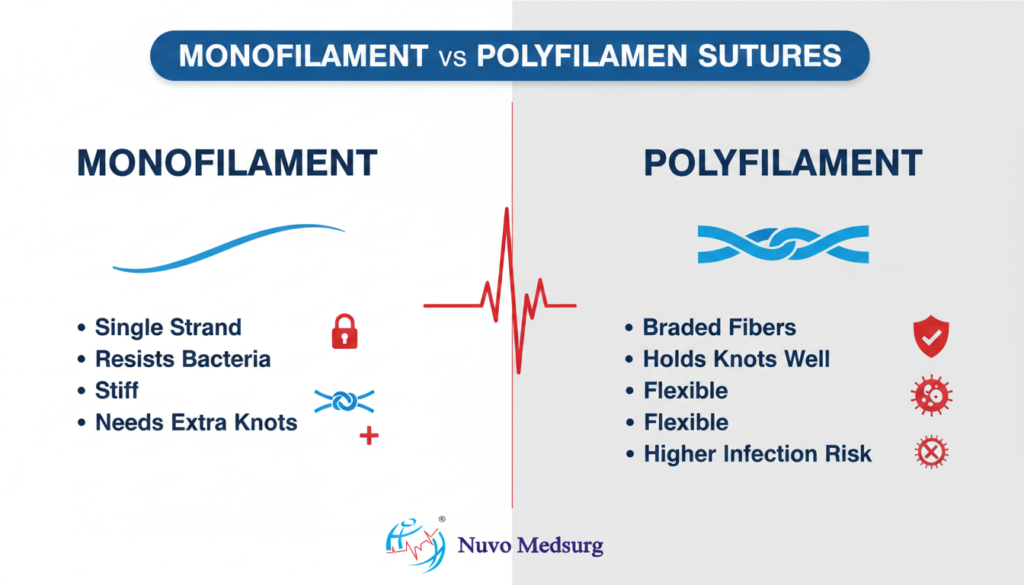
Surgeons choose between monofilament vs polyfilament sutures for surgical sutures to aid healing. Nuvo Medsurg provides options for both.
-
Monofilaments are single strands. They resist bacteria but need extra knots due to stiffness.
-
Polyfilaments are braided fibers. They hold knots well and stay flexible.
-
These carry a higher risk of infection compared to single strands.
Understanding Suture Structures: Monofilament Vs Polyfilament
Choosing between monofilament vs polyfilament sutures depends on how the thread is built. These surgical sutures come in different designs for specific body tissues.
A monofilament suture is one solid strand of material. It has a smooth, uniform shape.
A polyfilament suture has many tiny fibers braided or twisted together.
Synthetic polymers dissolve in the body through a water-based process called hydrolysis. Natural fibers break down through enzymes. Surgeons pick the structure based on the specific repair needed. Always talk to a doctor about medical procedures and recovery.
What Is A Monofilament Suture?
A monofilament suture is a single continuous strand of material. Surgeons use this type of thread because it creates very little tissue drag when it passes through the skin or organs. This prevents small injuries to the body during a procedure. Because the material has high memory, the thread stays stiff. This stiffness means the surgeon must tie the knots with extra care so they stay in place. Doctors often choose surgical sutures based on how these properties affect the healing process.
Common materials include:
-
Polydioxanone
-
Polypropylene
-
Nylon
What Is A Polyfilament Suture?
A multifilament suture consists of several small fibers braided or twisted together. This structure makes the thread very flexible and easy to handle during surgery. These traits lead to great knot security, which helps keep wounds closed. However, these threads can have high capillarity. This means the material might soak up fluids and carry bacteria along the strand. Also, some braided threads can cause a sawing effect that may irritate or damage tissue if the surgeon pulls too hard. You can find more details on these surgical sutures through medical supply catalogs.
Common materials include:
-
Silk
-
Polyglactin 910
-
Polyester
Monofilament Sutures: Benefits, Limitations, and Clinical Uses
Monofilament vs polyfilament sutures selection often favors monofilaments when reducing a surgical site infection is the main goal. These threads consist of a single strand. Their smooth and non-porous surface stops bacteria from hiding or moving along the thread. This makes them safer for clean surgical areas. Because they have very little friction, surgeons use them often for delicate cardiovascular surgery and cosmetic dermatological procedures.
Surgeons must handle these threads with care. A needle holder can easily damage the material. If a surgeon crushes the strand, it loses its tensile strength quickly. These threads are also prone to structural kinking if handled roughly.
|
Target tissue |
Benefit |
|---|---|
|
Cardiovascular tissue |
Low friction reduces trauma |
|
Skin |
Smooth surface prevents infection |
|
Vascular structures |
Glides easily through delicate layers |
-
Do not crush with needle holders.
-
Avoid sharp bending or kinking.
-
Use gentle pressure to maintain integrity.
Polyfilament Sutures: Handling, Strength, and Risks
Monofilament vs polyfilament sutures comparison shows that polyfilaments are better when a doctor needs high tensile strength and superior knot security. These threads consist of many tiny fibers braided together. This design makes them very flexible. Surgeons can tie secure knots with fewer throws. Makers often add a special coating to these threads. This coating helps the thread slide through tissue without dragging. It also helps prevent capillarity, which is the movement of fluid along the thread.
Warning: Do not use braided threads in contaminated wounds. They should also stay away from the urinary bladder. The braided structure can trap bacteria or lead to the formation of calculi. Always talk to a medical professional if you have questions about wound healing.
Head-to-Head Comparison: Physical and Performance Characteristics
Comparing monofilament vs polyfilament sutures helps surgeons choose the right tool for a specific procedure. A trial by the Karolinska Institute on 988 patients showed that continuous monofilament sutures close abdominal wounds in 7.1 minutes. Interrupted polyfilament sutures took 8.7 minutes. Both methods showed an identical 1 percent rate of wound dehiscence, which confirms they offer the same structural reliability.
Monofilament strands slide through tissue easily because they have a smooth surface. This creates a low tissue reaction. However, they can be stiff and harder to tie. Polyfilament strands offer better flexibility and knot security, but their braided texture can sometimes increase bacterial adherence.
|
Feature |
Monofilament |
Polyfilament |
|---|---|---|
|
Tissue Drag |
Low |
High |
|
Knot Security |
Moderate |
Excellent |
|
Memory |
High |
Low |
|
Infection Risk |
Low |
Higher |
|
Tensile Strength |
Consistent |
Variable |
Surgeons balance these traits to manage risks like incisional hernia formation. This is a perplexing but necessary part of surgical planning.
Conclusion
Choosing the correct material in the monofilament vs polyfilament sutures comparison ensures better clinical outcomes. Nuvo Medsurg provides high-quality surgical sutures to support medical teams across India. These products combine expert manufacturing with affordable pricing to assist in patient care.
Frequently Asked Questions
Q: Why are monofilaments preferred in infected wounds?
A: Monofilaments lack tiny braided gaps. This stops bacteria from moving along the strand.
Q: Which suture provides better knot security?
A: Polyfilament sutures hold knots better. Their rough surface stops knots from slipping.
Q: What is suture memory?
A: It is the thread’s inclination to return to its original straight shape. This trait is very obvious in stiff monofilaments.
Q: What does capillarity mean for surgical threads?
A: It means the material can soak up fluids and carry them along the strand. This trait is common in braided threads and increases the risk of spreading bacteria.
Q: Where should surgeons avoid using polyfilament sutures?
A: Braided threads should never be used in contaminated wounds or the urinary bladder. Their textured structure can trap bacteria or lead to the formation of calculi.


