
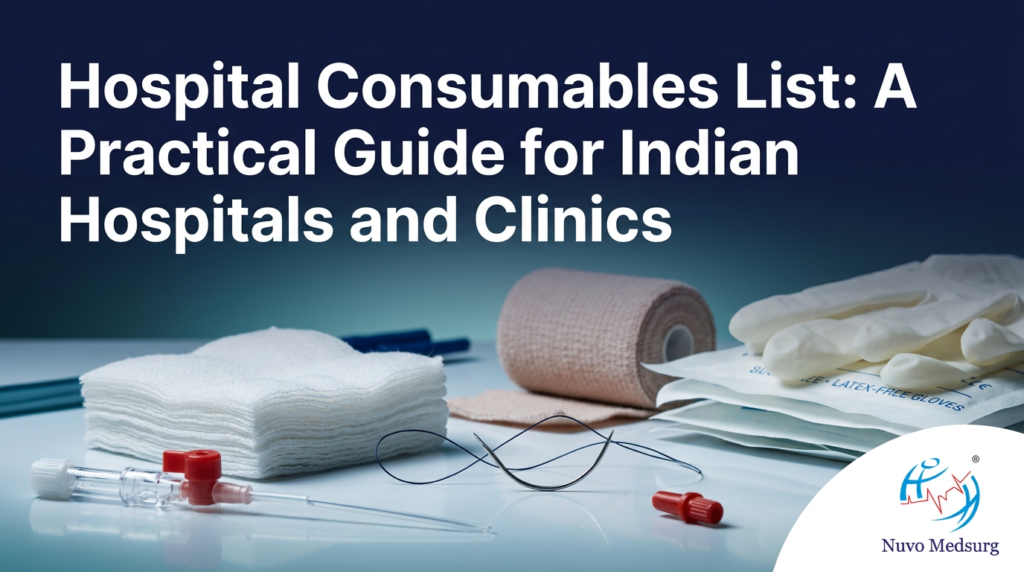
Every hospital, clinic, and surgical centre runs on a steady supply of consumables: the sutures, gloves, gauze, dressings, and disposables that get used once and replaced. A missing item on the day of a procedure can delay care and frustrate a surgical team. This guide sets out what counts as a hospital consumable, how to group them by department, and how to build a reorder system that keeps shelves stocked without tying up capital in excess stock.
Quick Answer
Hospital consumables are single-use medical items such as sutures, gloves, gauze, dressings, and disposables that are replaced after each use. A working list groups them by department, tracks minimum and maximum stock levels, and checks that every item carries valid quality certification such as ISO 13485, CE, or FDA clearance before it reaches a patient.
What Counts as a Hospital Consumable
A consumable is any item a hospital uses once and discards, as opposed to reusable equipment like monitors or surgical instruments that get sterilised and used again. Surgical sutures, skin staplers, bandages, examination and surgical gloves, gauze, cotton wool, disinfectant wipes, wound dressings, and surgical disposables such as drapes and gowns all fall into this category. Pharmaceuticals and implants are usually tracked separately from general consumables because they follow different procurement and storage rules. Getting the boundary right matters for budgeting: consumables are a recurring operating cost, not a one-time capital purchase, so they need their own line in the procurement plan and their own reorder rhythm.
Core Consumable Categories by Department
Different departments draw on different consumable categories, and a useful inventory list reflects that rather than treating the hospital as one undifferentiated stockroom.
Operation Theatre Consumables
The operation theatre uses the highest-value consumables: sutures, skin staplers, surgical gloves, drapes, gowns, and sterile dressings for closing and covering incisions. These items need the tightest quality control because they contact tissue directly during a procedure. Theatre stock should be tracked by procedure type, since a general surgery list and an orthopaedic list draw on different suture gauges and stapler sizes.
General Ward and Outpatient Consumables
Wards and outpatient departments use higher volumes of lower-cost items: gauze, cotton wool, bandages, examination gloves, and disinfectant wipes for daily dressing changes and routine care. Because these items move fast, wards are where stock-outs happen most often if reorder points are set too low.
Emergency and ICU Consumables
Emergency and intensive care areas need a mix of both: dressings and staplers for trauma closure, alongside high volumes of gloves and wipes for infection control in a high-turnover setting. Because emergency demand is unpredictable, these areas typically carry a larger buffer stock than scheduled departments.
Building a Consumables Inventory and Reorder System
Start with a master list organised by department, then attach a minimum and maximum stock level to each item based on average weekly usage. A reorder point, the stock level at which a new purchase order gets triggered, prevents both stock-outs and overstocking. Many hospitals now track this through inventory software rather than paper registers, since software can flag items approaching their minimum automatically and log batch numbers and expiry dates for traceability. Expiry tracking deserves particular attention for gauze, dressings, and disinfectant wipes, which have shelf lives that are easy to overlook next to higher-profile items like sutures. A first-expiry-first-out rotation on the shelf keeps older stock moving before it lapses. Reviewing usage data every quarter also helps a procurement team catch seasonal patterns, such as higher demand for dressings and disinfectant during monsoon-related infection spikes.
Quality Standards and Certifications to Check
Every consumable that touches a patient should carry documented quality certification, not just a manufacturer's claim on the box. ISO 13485 confirms that a manufacturer's quality management system meets the international standard for medical devices. CE marking indicates conformity with European medical device regulation, and FDA clearance or registration signals that a product meets United States requirements. A procurement team should ask any supplier for copies of these certificates and check that they cover the specific product being purchased, not just the company as a whole. Nuvo Medsurg manufactures sutures, staplers, dressings, and surgical disposables under ISO 13485, CE, and FDA certification, and any buyer working with a new supplier should expect the same level of documentation as a baseline, regardless of brand.
Conclusion
A hospital consumables list is only useful when it is organised by department, backed by clear reorder points, and checked against real quality certification rather than assumed. Building that system takes an upfront effort, but it pays back every time a theatre list is complete on the morning of a procedure and a ward never runs short of dressings. Nuvo Medsurg supplies sutures, staplers, gloves, gauze, dressings, and surgical disposables to hospitals and clinics across India and more than fifteen other countries, and its full product range is available at https://nuvomedsurg.com/.
Reviewed by the Nuvo Medsurg clinical content team.
Frequently Asked Questions
How often should a hospital review its consumables list?
Most hospitals review usage data and reorder points quarterly, with a full list audit at least once a year to add new items and retire discontinued ones.
What is the difference between a consumable and a medical device?
A consumable is used once and discarded, such as gauze or a suture, while a medical device like a monitor or an instrument is reused after cleaning and sterilisation.
Should small clinics maintain the same categories as large hospitals?
Yes, though at smaller volumes. A clinic still needs theatre-style, ward-style, and emergency-style categories, just with lower minimum and maximum stock levels.
How do you prevent consumables from expiring on the shelf?
Use a first-expiry-first-out rotation, label batches clearly on arrival, and review expiry dates during every stock count rather than only at the point of use.
What certifications should a consumables supplier be able to show?
At minimum, ISO 13485 for quality management, plus CE marking or FDA clearance depending on the markets the products are sold into.


