
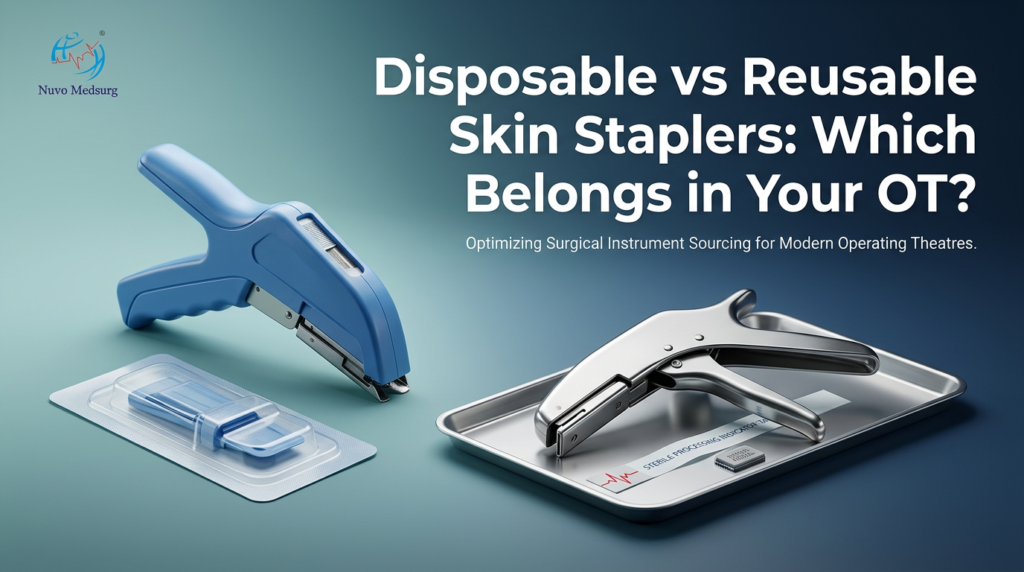
Skin staplers have earned a permanent place next to sutures in most Indian operation theatres, valued for closing incisions faster and with more even tension than hand suturing. But the purchasing decision behind them rarely gets the same scrutiny as the technique itself.
Quick Answer
Disposable staplers win on simplicity and infection control margin. Reusable staplers win on cost per procedure at high volume. The right choice depends on how many procedures your OT runs per week and how reliable your sterilisation department actually is.
Quick Comparison
| Disposable | Reusable | |
| Reprocessing required | No | Yes, handle sterilised between cases |
| Upfront cost | Low, no capital outlay | Higher, durable handle investment |
| Best fit | Lower-volume clinics, outreach camps | High-volume hospitals with strong sterile services |
Upfront and Long-Term Cost
Disposable staplers carry a predictable per-unit cost every time, with no equipment to buy. Reusable staplers need a larger upfront investment in the handle, but once amortised across dozens of procedures, the ongoing cost per case, mostly just the cartridge, tends to come in lower. Verdict: disposable wins for low volume, reusable wins once volume is consistently high.
Sterilisation and Infection Control
Every disposable unit arrives sterile and is used once, removing reprocessing error entirely. Reusable staplers are just as safe in principle, but only if the central sterile services department follows cleaning and sterilisation protocol correctly every time. Verdict: disposable wins on guaranteed sterility; reusable can match it only with disciplined infrastructure.
Performance and Training
Both formats fire consistently when used correctly, though reusable handles can wear mechanically over repeated sterilisation cycles if kept in service too long. Disposable staplers also need less training, since staff only learn firing technique rather than disassembly and reprocessing. Verdict: disposable wins on training simplicity and long-term predictability.
Making the Procurement Call
A high-volume tertiary hospital with an audited sterile services department typically comes out ahead on reusable systems over a year. A smaller clinic, day-care centre, or outreach team without reliable sterilisation access is usually better served by disposables, even at a higher per-unit cost, because it removes both the infrastructure investment and the infection control risk.
Conclusion
Neither format is universally correct. The facilities that get this decision right honestly assess their own surgical volume and sterilisation reliability before ordering. Nuvo Medsurg manufactures skin staplers built for reliable, consistent closure across both high-volume and smaller clinical setups. The range is available at https://nuvomedsurg.com/.
Reviewed by the Nuvo Medsurg clinical content team.
Frequently Asked Questions
Are reusable staplers as safe as disposable ones?
When sterilisation protocols are followed correctly every time, yes. The risk lies in inconsistent reprocessing, not the device design.
Do disposable staplers cost more in the long run?
For very high-volume facilities, yes, since the per-use cost compounds over hundreds of procedures compared to a reusable system’s amortised cost.
Can the same stapler be used across different surgical specialties?
Most standard skin staplers are versatile enough for general surgery, orthopaedic, and obstetric closures, though surgeons should confirm compatibility with wound type.
How many staples does a typical stapler cartridge hold?
This varies by model, typically 15 to 35 staples, so surgeons should confirm cartridge capacity against expected wound length beforehand.
Can a reusable stapler handle be used indefinitely?
No, even well-maintained handles have a defined service life and should be retired once the manufacturer’s recommended use cycles are reached.


