
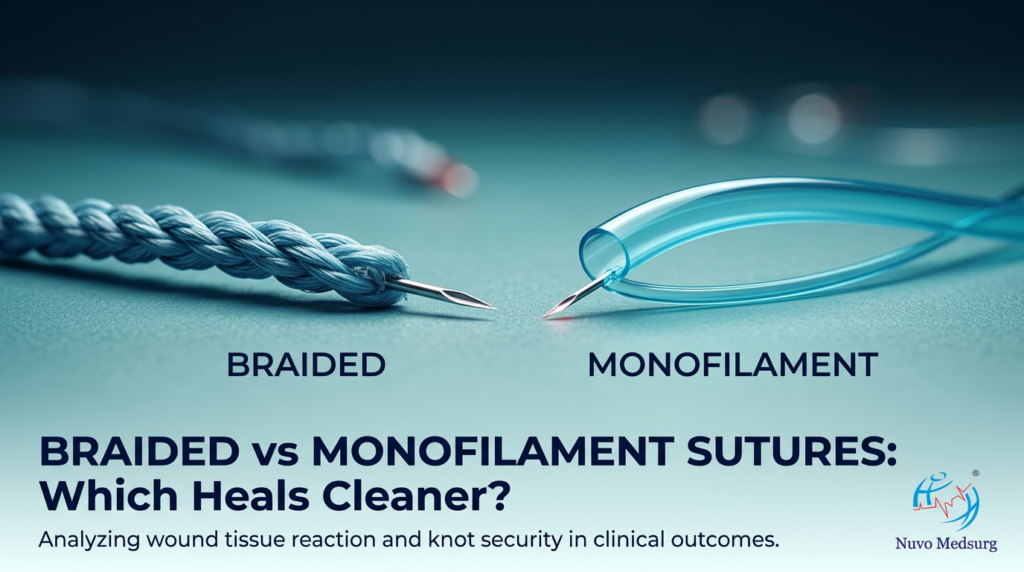
Suture selection rarely comes down to material alone. Two sutures can be chemically similar, both absorbable or both non-absorbable, and still behave completely differently in tissue depending on whether the strand is a single filament or several fibres woven together.
Quick Answer
Monofilament sutures generally heal cleaner in contaminated fields, since they lack the microscopic gaps that let braided material wick bacteria along the suture line. Braided sutures win on handling and knot security, which is why most operations end up using both in different layers.
Quick Comparison
| Braided | Monofilament | |
| Structure | Multiple filaments woven together | Single smooth strand |
| Knot security | Holds with 3-4 throws | Needs 5-6 throws |
| Infection risk | Higher, due to wicking | Lower, no gaps to wick fluid |
Structure and Tissue Handling
Braided sutures are woven from several filaments, giving them excellent flexibility and easier tying than a stiffer single strand. Monofilament sutures are a single smooth strand with no interstitial spaces, which lets them glide through tissue with less resistance but makes them slightly less forgiving to tie precisely. Verdict: braided wins on handling, monofilament wins on smooth passage.
Knot Security
The woven surface of a braided suture creates more friction, so it typically holds securely with three to four throws as a proper square knot. Monofilament's smooth surface needs five to six throws to reach equivalent security, and under-throwing it out of habit formed on braided material is a common, avoidable cause of knot failure. Verdict: braided wins clearly on knot security per throw.
Infection Risk and Best Applications
Braided sutures have microscopic gaps that can wick bacteria-laden fluid along the suture tract. Coating reduces this significantly but does not eliminate it, which is why monofilament is generally preferred in contaminated or infection-prone fields, vascular work, and skin closure. Braided sutures still suit deep dermal closures, muscle and fascia approximation in clean fields, and vessel ligation, where secure knotting matters more than minimal infection risk. Verdict: the tissue layer and contamination level decide the winner, not a blanket preference.
Cost and Procurement
Neither construction is consistently cheaper; pricing depends more on base material, coating, and gauge than on braided versus monofilament construction itself. The more relevant procurement question is batch consistency, since variation between manufacturing batches changes how a suture handles under identical tying technique.
Conclusion
"Which heals cleaner" has a real answer, monofilament, but "which suture should you use" does not, because most operations need both constructions in different layers. Nuvo Medsurg manufactures both braided and monofilament sutures, absorbable and non-absorbable, for general, orthopaedic, and gynaecological procedures. The full range is available at https://nuvomedsurg.com/.
Reviewed by the Nuvo Medsurg clinical content team.
Frequently Asked Questions
Does braided suture always cause more infection?
Not always. Coated braided sutures reduce capillarity significantly, and infection risk depends heavily on surgical technique and wound contamination too.
Can monofilament sutures be used in infected wounds?
Yes, monofilament is often preferred for infected or contaminated wounds precisely because it resists the wicking effect seen with uncoated braided material.
Can braided and monofilament sutures be mixed in the same procedure?
Yes, this is standard practice, with braided used for deeper layers and monofilament reserved for skin or vascular closure.
Does suture gauge matter more than construction type?
Both matter independently; gauge is chosen for the tissue's tensile demands, while construction is chosen for handling and infection-risk profile.
Can a monofilament suture used for skin be removed like a regular stitch?
Only if it is non-absorbable, like nylon; absorbable monofilament materials such as polydioxanone are left in place and dissolve on their own.


