
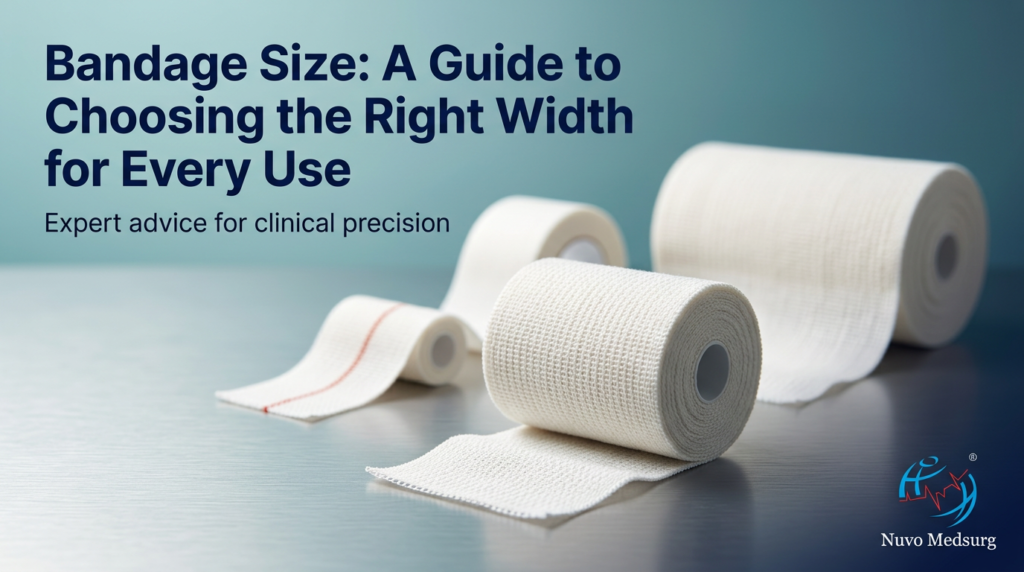
Stocking the wrong bandage sizes is a quiet but common problem in Indian hospitals and clinics. A roll that is too narrow fails to cover a wound properly, while one that is too wide wastes material and is hard to secure. This guide explains why bandage size matters, the common width categories, how to match size to body region, and how to build a stock range that covers paediatric and adult patients alike.
Quick Answer
Bandage width should match the body part being wrapped: narrow bandages for fingers and small joints, medium widths for limbs, and wider bandages for the thigh, abdomen, or trunk. Stocking a small range of widths, rather than one universal size, covers most clinical needs efficiently.
Why Bandage Size Matters
Bandage size affects both wound coverage and how securely a dressing stays in place. A bandage too narrow for the area requires more overlapping turns to achieve full coverage, which uses more material and takes longer to apply. A bandage too wide bunches or folds when wrapped around a small area, creating uneven pressure points that can irritate skin or slip during patient movement. Correct sizing also affects circulation safety, since an appropriately sized bandage distributes pressure evenly, while a mismatched size concentrates pressure on the fold points, especially in compression bandaging.
Common Bandage Width Categories
Bandages are generally supplied in a handful of standard width categories that cover most clinical needs. Narrow bandages, roughly two to three inches wide, suit fingers, toes, and small dressings. Medium bandages, around four to six inches, are the most frequently used size and cover most limb wounds, from forearms to lower legs. Wider bandages, above six inches, are used for the thigh, hip, shoulder, or abdominal wrapping where the area to cover is larger. Some facilities also stock an extra-narrow size for paediatric finger and toe injuries, and an extra-wide size for bariatric patients or large trunk dressings. Nuvo Medsurg manufactures bandages across these standard width categories for hospital and clinic procurement.
Matching Bandage Size to Body Region
Matching size to region starts with the diameter and shape of the body part. Fingers and toes need narrow bandages that can wrap snugly without excess material bunching at the joint. The forearm, wrist, and lower leg work well with medium-width bandages, since this size balances coverage with ease of handling for the person applying it. The thigh, upper arm, and shoulder need wider bandages to achieve full coverage without an excessive number of overlapping turns. Head and scalp dressings often use a specific triangular or tubular bandage rather than a standard roller width, since the shape of the head does not suit a flat wrap in the same way limbs do.
Paediatric Versus Adult Bandage Sizing
Children's smaller limb circumference means adult-width bandages often do not sit correctly on paediatric patients. A medium bandage sized for an adult forearm can be too wide for a child's arm, leading to excess overlap and a bulkier dressing than necessary. Paediatric care generally calls for narrower bandages across most body regions compared to the equivalent adult wrap. Using correctly sized paediatric bandages also makes it easier for a child to keep the dressing in place and reduces the discomfort of an overly bulky wrap. Verdict: paediatric patients need consistently narrower bandage widths than adults across almost every body region, so a facility treating children needs its own dedicated size range rather than adult stock trimmed down.
Stocking the Right Range of Bandage Sizes
A well-stocked facility keeps a small set of core widths rather than a single universal size or an excessive number of variants. Most outpatient departments and wards do well with a narrow, medium, and wide option, supplemented by a paediatric-specific width if the facility treats children regularly. Surgical centres handling a wider variety of procedures may add an extra-wide option for trunk and hip dressings. Reviewing actual usage patterns over a few months helps identify which widths run out fastest, so reordering can be adjusted before a commonly used size runs short during a busy period.
Signs You Are Using the Wrong Bandage Size
A few practical signs point to a size mismatch before it causes a bigger problem. If a bandage needs more than three or four overlapping turns to cover a wound fully, the width is probably too narrow for that body region. Visible bunching, folding, or twisting along the wrap usually means the bandage is too wide for the area being covered. A bandage that keeps slipping down a limb within an hour of application often indicates the width does not match the taper of the body part, since a poor size fit struggles to grip evenly. Staff who notice these patterns repeatedly on the same body region should review their stocked sizes rather than continuing to compensate with extra tape or more turns.
Conclusion
Choosing the correct bandage size is a small decision that has a direct effect on wound coverage, patient comfort, and how securely a dressing stays in place. Stocking a focused range of widths, including a paediatric option where needed, covers most clinical situations without overcomplicating inventory. Nuvo Medsurg manufactures bandages across narrow, medium, and wide sizes for hospitals, clinics, and surgical centres; visit https://nuvomedsurg.com/ to see the available range.
Reviewed by the Nuvo Medsurg clinical content team.
Frequently Asked Questions
What bandage width is best for a sprained ankle?
A medium-width elastic bandage, typically in the four to six inch range, gives even compression around the ankle joint without excessive bunching.
Is there a standard bandage size used across all hospitals in India?
There is no single mandated standard, but most facilities stock similar narrow, medium, and wide categories that align with common manufacturer sizing.
How do I know if a bandage is too tight after wrapping?
Check the skin colour, warmth, and sensation beyond the bandage; paleness, numbness, or coldness signals the wrap is too tight and should be loosened.
Should paediatric wards stock separate bandage sizes from adult wards?
Yes, paediatric patients generally need narrower widths across most body regions, so a dedicated paediatric size range improves fit and comfort.
Can one bandage width be used for the entire body in an emergency?
A medium width can serve as a temporary solution across several body regions in an emergency, but it should be replaced with a correctly sized bandage once the situation allows.


