
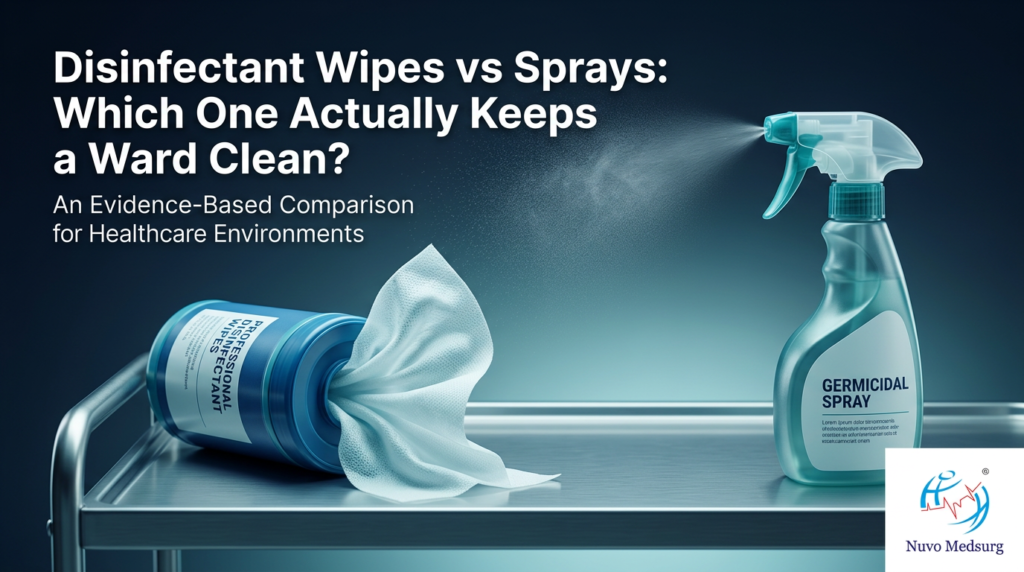
Walk into any OT complex during a shift change and you'll usually find both sitting on the same trolley: a spray bottle and a tub of wipes. Staff reach for whichever is closer, not whichever works better for that surface. That habit quietly costs hospitals money, and sometimes the contact time they never actually got. Wipes and sprays are sold as if they're interchangeable. They aren't. This piece looks at where each genuinely belongs in a clinical setting, and where reaching for the wrong one undoes the point of disinfecting entirely.
Quick Answer
Wipes win on consistency and speed for small, high-touch surfaces; sprays cover larger areas faster, but the result depends heavily on how thoroughly staff wipe them down afterward. Neither is the better product outright. The surface, the time available, and who's doing the cleaning decide which one actually works.
| Factor | Wipes | Sprays |
| Contact time / efficacy | Consistent, pre-dosed | Variable, depends on spray coverage |
| Surface suitability | Small equipment, rails, monitors | Large flat surfaces, floors, walls |
| Ease of use | Grab and wipe, no dilution | Needs even application and a separate cloth |
| Cost per use | Higher per surface wiped | Lower per litre, more waste if oversprayed |
| Best application | Bedside rails, IV poles, stethoscopes | OT floors, large counters, walls |
Why Contact Time Decides Everything
Every disinfectant needs the surface to stay wet for a set period before the claimed kill rate means anything. Most alcohol-based products need a minute or two of visible wetness; quaternary ammonium formulations need longer, sometimes several minutes. Wipes are pre-saturated, so a single pass leaves a consistent film. Sprays are a different story. Spray it thin, wipe immediately, and the surface can dry in under twenty seconds, well before the chemistry has done its job. A nurse in a hurry, moving fast through a discharge clean, is exactly the person most likely to under-dose a spray without noticing.
Surfaces That Punish the Wrong Choice
Spray a keyboard, a patient monitor, or an infusion pump the same way you'd spray a countertop, and liquid pools in the seams. That's how equipment fails months before it should. Wipes control exactly how much liquid touches a surface, which matters around electronics. Sprays make more sense on floors, walls, large counters, and OT tables between cases, where volume matters more than precision. Fabric curtains sit awkwardly in between: neither format disinfects them well, and most infection control protocols call for laundering instead.
What Actually Happens on a Busy Ward Round
Picture a night shift nurse moving bed to bed, checking vitals every few hours. She doesn't have three minutes per rail to spray, wait, and wipe. She has maybe fifteen seconds. A wipe pulled straight from the dispenser gets the job done inside that window, because the dosing is already built in. In an isolation room, where a doctor examines a patient and needs to disinfect a stethoscope before the next visit, the same logic holds. Speed without cutting corners is the entire appeal of a wipe on rounds.
The Real Cost Difference
Wipes cost more per surface cleaned. That's just arithmetic; a drum of concentrate diluted into a spray bottle costs less per litre than the same chemistry packed one dose per wipe. But cost per use isn't cost per outcome. Oversprayed bottles waste product on runoff, and under-sprayed ones fail to disinfect at all, so hospitals often end up buying more spray than they need. Nuvo Medsurg supplies both formats, and many facilities that track consumption closely settle on wipes for patient-zone surfaces and sprays for terminal cleaning of an empty room, splitting the budget instead of standardising on one.
When Wipes Are the Right Call
Bed rails, call bells, IV poles, blood pressure cuffs, stethoscope diaphragms: anything touched repeatedly between formal cleaning rounds belongs in wipe territory. Between-patient cleaning in outpatient clinics runs faster with wipes too, since there's no bottle to fetch and no cloth to launder. Dental chairs and minor procedure trolleys fall into the same category. If a surface gets touched every few minutes, a wipe keeps pace in a way a spray bottle can't.
When a Spray Earns Its Place
Terminal cleaning after a discharge, especially from an isolation bed, means covering a lot of ground fast: bed frame, locker, floor, wall panels near the headboard. A spray with a cloth gets through that in a fraction of the time wipes would take. OT floors between cases, sluice rooms, and large equipment housings are the other obvious fit. Anywhere the job is measured in square metres rather than touchpoints, a spray usually makes more sense.
Conclusion
Neither format replaces the other. A ward stocking only sprays or only wipes is usually cutting a corner somewhere, whether that's speed at the bedside or coverage during terminal cleaning. The smarter approach matches format to surface: wipes for high-touch equipment, sprays for floors, walls, and large-scale cleans. Nuvo Medsurg manufactures both disinfectant wipes and sprays to ISO 13485 and CE standards, built for exactly this kind of mixed-use hospital environment. Browse the range at https://nuvomedsurg.com/.
Reviewed by the Nuvo Medsurg clinical content team.
Frequently Asked Questions
Can wipes and sprays use the same active ingredient?
Yes, many products in both formats use the same alcohol or quaternary ammonium base; the difference is delivery and dosing, not the chemistry.
How long should a surface stay visibly wet for disinfection to work?
It depends on the label, but most hospital-grade products need somewhere between one and five minutes of visible wetness, and drying the surface early cuts the kill rate short.
Are disinfectant wipes safe to use on skin or wounds?
No. Surface disinfectant wipes are formulated for equipment and hard surfaces, and using them near open wounds or mucous membranes can cause irritation.
Do sprays clean a full ward faster than wipes?
For large open areas, yes, since one spray application covers more surface area per second than wiping by hand.
Which format lowers cross-contamination risk more?
Single-use wipes reduce the risk of spreading contamination between surfaces, since each one is meant to be used once and discarded, unlike a reused cloth with spray.


