
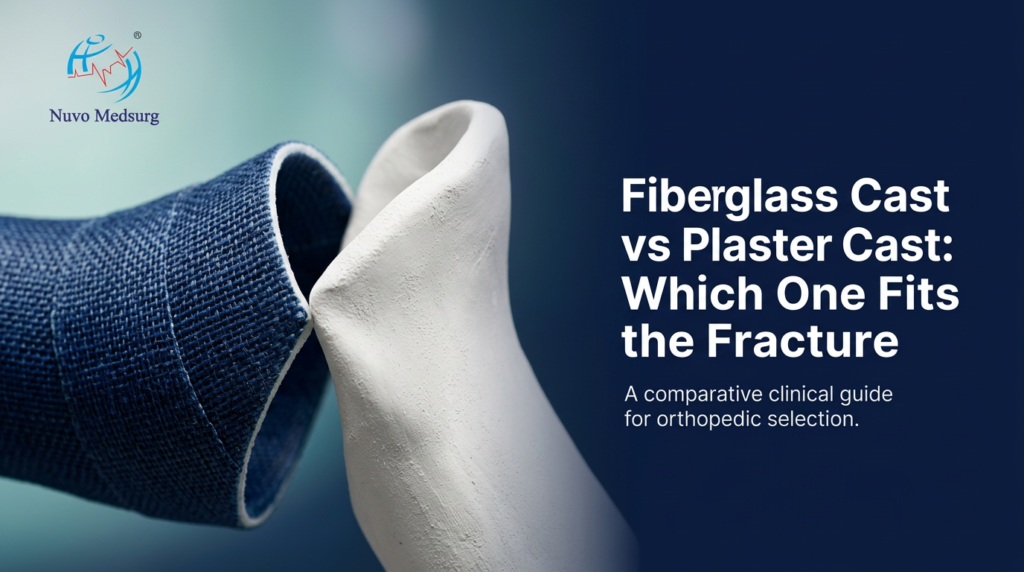
Ask an orthopaedic resident which cast material they reach for first, and the answer usually depends on the fracture, not personal preference. Plaster of Paris has splinted broken bones for over a century and still shows up in casualty wards across India for its low cost and easy moulding. Fiberglass arrived later, lighter and tougher, and now dominates in busy trauma centres where patients need to walk out the same day. Neither has made the other obsolete; they solve different problems.
Quick Answer
Fiberglass casts are lighter, more water-resistant, and cure faster, making them the default for active patients and long-term wear, while plaster casts remain cheaper and easier to mould precisely, which is why many surgeons still prefer them for fresh fractures needing close contouring. The table below breaks down the practical differences.
| Factor | Plaster Cast | Fiberglass Cast |
| Weight | Heavier | About half the weight |
| Setting time | 10-15 minutes to set, days to fully dry | Sets in 5-15 minutes, ready to bear weight sooner |
| Water resistance | Softens and breaks down if wet | Resists moisture; some liners tolerate brief wetting |
| Cost | Lower | Higher |
| X-ray clarity | Slightly obscures fine detail | More radiolucent, sharper images |
Material and Weight
Plaster of Paris is cotton bandage impregnated with calcium sulfate, the same chemistry that hardens into gypsum plaster on a wall. It is heavy, especially on a long leg cast, and that weight adds up over six weeks for a patient who still has to get to work or manage stairs at home. Fiberglass is woven glass fibre coated in a polyurethane resin, roughly half the weight of an equivalent plaster cast, and it keeps that advantage even as the cast gets bigger. For a child with a forearm fracture, or an elderly patient already unsteady on their feet, that difference changes how easily they manage stairs, autos, and daily life during recovery.
Setting and Drying Time
Plaster sets within ten to fifteen minutes but takes one to three days to reach full hardness, depending on humidity and cast thickness. Fiberglass sets faster and reaches near-full strength within an hour, sometimes less. In a high-volume casualty department, that gap matters. A resident applying a dozen casts a shift cannot always wait a full day before clearing a patient for discharge, and fiberglass simply moves people through faster without compromising the fixation.
Durability and Water Resistance
Plaster hates water. A wet plaster cast turns soft, sags, and can lose its shape entirely, which is a real problem in Indian monsoon months when a patient's commute home might involve wading through a flooded street. Fiberglass shrugs off splashes far better, and some fiberglass casts, including Nuvo Medsurg's casting tape, are paired with waterproof padding that lets a patient shower without a plastic bag taped over their arm. Neither material likes full submersion for long periods, and surgeons still tell patients to keep both types reasonably dry, but the margin for error is much wider with fiberglass.
Cost Considerations for Indian Hospitals
Plaster costs less per roll, sometimes a fraction of what fiberglass costs, and that difference matters at scale for government hospitals and high-volume trauma centres treating hundreds of fractures a month. Private clinics and patients who can absorb the extra cost often choose fiberglass anyway, for the comfort and convenience it offers over six or eight weeks of immobilisation. A district hospital casualty department might stock plaster as the default for straightforward fractures and keep fiberglass on hand for paediatric patients, athletes, or anyone whose job demands they stay mobile.
X-ray Visibility and Follow-up Imaging
Fracture healing has to be checked, usually at two weeks and again near the end of immobilisation, and the cast stays on through both scans. Fiberglass is more radiolucent, so the fracture line and callus formation show up more clearly on X-ray without needing to bivalve or remove the cast. Plaster is not opaque by any means, radiographers read through it every day, but a thick plaster cast on a large limb can soften fine detail at the fracture margins. For fractures where the surgeon expects to fine-tune alignment on follow-up films, that clarity has genuine value.
Which Suits Which Fracture and Patient
Fresh, unstable fractures that need careful moulding around the injury often start in plaster, because it can be shaped by hand before it sets. Once swelling has gone down and the fracture is stable, many surgeons switch the patient to a lighter fiberglass cast for the remaining weeks. Children tolerate fiberglass better simply because it is lighter and comes in colours they will actually agree to wear. Elderly patients with a wrist fracture, or anyone who needs to keep working through a lower leg injury, usually do better in fiberglass too. Cost-sensitive settings, and cases where a snug, exact mould matters more than convenience, still lean on plaster.
Conclusion
Neither material wins outright. Plaster remains the cheaper, more mouldable choice for fresh or complex fractures, while fiberglass earns its higher price with lighter weight, better water resistance, and clearer imaging. The right call depends on the fracture, the patient's daily demands, and what the hospital can afford to stock at volume. Nuvo Medsurg supplies both plaster of Paris bandages and fiberglass casting tape to hospitals and clinics across India, available through https://nuvomedsurg.com/.
Reviewed by the Nuvo Medsurg clinical content team.
Frequently Asked Questions
Can a fiberglass cast get fully wet?
Only if it has a waterproof liner designed for that; a standard cotton-padded fiberglass cast still needs to stay dry underneath.
Is fiberglass stronger than plaster?
Generally yes, for the same thickness, though a well-applied plaster cast on a stable fracture is still perfectly adequate.
Why do some hospitals only stock plaster?
Cost and volume. Government and high-turnover trauma units often cannot justify fiberglass pricing across every case.
Does the cast material affect healing time?
No. Bone heals at the same rate either way; the material only affects comfort, weight, and how the limb is protected during that period.
Can a plaster cast be converted to fiberglass midway through treatment?
Yes, and it is fairly common once initial swelling subsides, the surgeon confirms the fracture is stable on X-ray, and the patient wants something lighter for the remaining weeks of immobilisation.


