
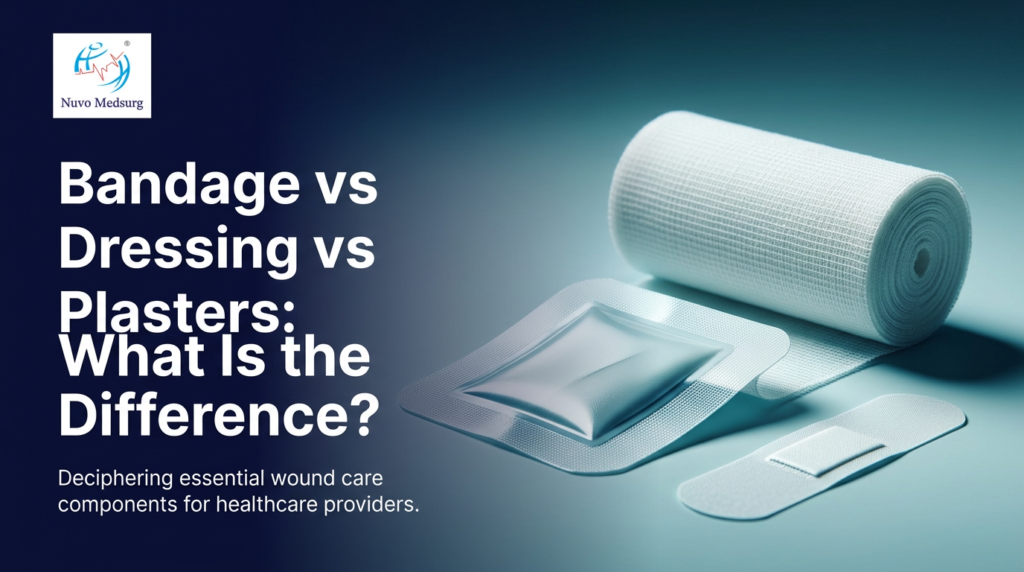
Patients and even new clinical staff often use the words bandage, dressing, and plaster interchangeably, but each product does a distinct job in wound care. Confusing them can lead to the wrong product being used, which slows healing or increases infection risk. Hospitals, clinics, and pharmacies need clarity on these terms both for correct clinical use and for accurate procurement. This article explains what separates a dressing, a bandage, and a plaster, and how they work together in standard wound management.
Quick Answer
A dressing covers a wound directly to protect it and support healing, a bandage holds a dressing in place or provides support, and a plaster combines a small dressing and adhesive in one product for minor wounds. Each serves a different stage of wound care.
| Product | Primary Function | Typical Use Case |
| Dressing | Covers and protects the wound bed | Surgical incisions, burns, ulcers |
| Bandage | Secures dressings or supports tissue | Holding gauze in place, sprains |
| Plaster | Combines dressing and adhesive in one | Small cuts, minor abrasions |
What Is a Dressing
A dressing is the material placed directly in contact with a wound to protect it, absorb fluid, and create conditions that support healing. Dressings range from simple gauze pads to advanced foam or hydrocolloid materials designed for specific wound types such as burns, ulcers, or surgical incisions. The main job of a dressing is direct wound contact, which means it must be sterile and suited to the amount of fluid the wound produces. Nuvo Medsurg manufactures a range of dressings, from basic gauze to specialised wound care products, for hospitals and clinics managing everything from minor cuts to complex post-surgical wounds.
What Is a Bandage
A bandage is a strip of material used to hold a dressing in place, apply pressure, or support an injured joint or limb. Unlike a dressing, a bandage does not usually touch the wound bed directly, since its role is mechanical: securing, compressing, or immobilising. Common types include crepe bandages for joint support, roller gauze bandages for holding dressings on a limb, and triangular bandages for slings. Bandages are reusable in some settings if they do not contact the wound directly, though hospital protocols generally favour single-use options for infection control in clinical environments.
What Are Plasters
A plaster, often called an adhesive bandage or sticking plaster, combines a small dressing pad with an adhesive strip in one ready-to-use product. It is designed for minor wounds such as small cuts, blisters, or abrasions that need light protection rather than the fluid management of a full dressing. The adhesive border holds the pad in place without needing a separate bandage, which makes plasters convenient for quick, low-risk wound care both in clinics and at home. Plasters are not suitable for wounds that are deep, heavily bleeding, or producing significant fluid, since the small pad cannot absorb enough to keep the wound properly managed.
How the Three Work Together
In many wound care situations, these three products work as a system rather than as alternatives to each other. A typical example is a moderate wound that is cleaned and covered with a sterile dressing, which is then held in place with a roller bandage wrapped around the limb. A plaster, by contrast, replaces both steps for a minor wound by combining the pad and the fastening into one product. Understanding this relationship helps clinical staff select the correct combination for a wound rather than reaching for whichever product is closest on the shelf. Verdict: dressings and bandages combine for moderate to serious wounds, while plasters serve as an all-in-one solution for minor injuries only.
Choosing the Right Product for a Wound
The size, depth, and fluid output of a wound should guide the choice between these products. Minor cuts and scrapes with little fluid are well served by a plaster alone. Wounds that need direct protection and fluid absorption call for a proper sterile dressing, secured if needed with a bandage. Wounds requiring compression, such as sprains or post-surgical swelling, need a bandage regardless of whether a dressing is also in place. Clinical staff should avoid using a plaster as a substitute for a proper dressing on anything beyond a minor, low-fluid wound, since it can trap moisture and slow healing on larger wounds.
Stocking Considerations for Hospitals and Clinics
Hospitals and clinics should stock all three product types in a range of sizes, since wound presentations vary widely across a single shift. Dressings should be available in multiple absorbency levels and sizes to match different wound types, from small surgical sites to larger burns or ulcers. Bandages should include both crepe and roller gauze varieties to cover support and securing needs. Plasters are useful in outpatient and emergency departments for the high volume of minor injuries that do not need a full dressing. Keeping a balanced stock of all three prevents staff from improvising with the wrong product during a busy shift.
Conclusion
Dressings, bandages, and plasters each play a distinct role in wound care, and knowing the difference helps clinical staff choose the right product instead of defaulting to whatever is on hand. Dressings protect the wound directly, bandages secure or support, and plasters combine both for minor injuries. Stocking all three in adequate variety keeps a hospital or clinic ready for any wound it encounters. Nuvo Medsurg supplies dressings, bandages, and related wound care disposables to healthcare facilities across India. Visit https://nuvomedsurg.com/ to view the full catalogue.
Reviewed by the Nuvo Medsurg clinical content team.
Frequently Asked Questions
What is the main difference between a dressing and a bandage?
A dressing makes direct contact with the wound to protect and absorb fluid, while a bandage secures the dressing in place or provides support without touching the wound bed.
Can a plaster be used instead of a dressing and bandage?
Only for minor wounds with little fluid, since a plaster combines a small pad and adhesive in one product that cannot manage larger or heavily bleeding wounds.
Are bandages reusable?
Some bandages, like crepe bandages that do not contact the wound directly, can be reused after cleaning, though hospitals generally prefer single-use options for infection control.
What type of dressing should be used for a surgical incision?
A sterile dressing suited to the amount of fluid the incision produces should be used, following the surgical team's specific wound care instructions.
Why should hospitals stock all three product types?
Wound presentations vary throughout a shift, so having dressings, bandages, and plasters available ensures staff always have the correct product for the size and type of wound they are treating.


